EVERY LITTLE THING

Welcome to "Every Little Thing", a blog discussing all 214 songs released by the Beatles from 1962 to 1970....by Daniel Seth Levine.

Monday, June 28, 2010

#119: Strawberry Fields Forever

Written by: John Lennon & Paul McCartney
Released: February 17, 1967
Appears on: Magical Mystery Tour
Lead vocal: John


There's something about "Strawberry Fields Forever" that is hard to pin down, even 43 years after its' release. The song is specifically about John's childhood, almost as if it is a more detailed version of "In My Life". I really believe that it's probably the best song he ever wrote in his life and easily a top-5 Beatles track. 
The lyrics touch on just how difficult it is to be a child in a confusing world and is filled with fantastic lines. That last verse probably sums up John's life, filled with hypocrisy and confusion, more than anything else he ever wrote:
Always know, sometimes think its me
But you know, I know when it's a dream
I think a 'no', I say 'yes,' 
But it's all wrong
That is, I think I disagree
Then there's the extreme psychedelic haze that these lyrics sit in. The track starts with Paul's mellotron notes, before John's subdued vocal comes in - Let me take you down, 'cause I'm goin' to...Strawberry Fields. John plays lead guitar, piano and maracas on the track while Paul adds bass to his mellotron parts. George plays a slide guitar and svarmandal, a unique Indian instrument that adds such a strange 'string' sound. Ringo's drumming reaches a high point, especially during the added coda section. It's a great little sequence, almost as if it was tacked on specifically to highlight Ringo. George Martin also arranged trumpet and cello sections, a pair of instruments that usually don't go together alone, adding another unique layer to the song. 
Probably the coolest part of the Anthology releases is the "Strawberry Fields Forever" sequence that opens up disc two of Anthology 2. It takes the song from demo stage to the first take and finally to the seventh take. For LOVE, George and Giles Martin created a unique mix by mixing all takes of the song into one, so by the time you get to the end, it is the fully realized master that we know and love. Here is the full wacky promo film
The song's only LP appearances include the US Magical Mystery Tour and as the opening track to 1967-1970
"Strawberry Fields Forever" is easily one of the most important and impacting Beatles songs. You will always hear it on the radio and it is very hard to hold back tears whenever I hear it. I listen to it often to remind myself to calm down whenever I'm stressed. It's a nice escape from reality, but I tend to take it as a reminder that Nothing is real...
    
Let me take you down, 
'cause I'm going to Strawberry Fields. 
Nothing is real,
and nothing to get hung about. 
Strawberry Fields forever. Strawberry Fields forever, 
Strawberry Fields forever, Strawberry Fields forever.


Next up: We start...the 'big' one. 

Sunday, June 27, 2010

#118: Penny Lane

Written by: John Lennon & Paul McCartney
Released: February 17, 1967
Appears on: Magical Mystery Tour
Lead vocal: Paul


It had been two months since a new Beatles release and six months since the last 100% new album. Then, out of the blue, not only did a new, double A-Sided single appear on store shelves, but a new single in a full-color sleeve. 
That single was easily their greatest and probably the greatest ever released by any group. 
"Penny Lane" b/w "Strawberry Fields Forever" (or is it "Strawberry Fields Forever" b/w "Penny Lane"?) blew the top of the lid to the other side of the solar system. Paul's "Penny Lane", an ode to the days of old in Liverpool, is, admittedly, more commercial than John's, so it appeared as the A-Side in Billboard. It hit #1 in the US for just a week before The Turtles' "Happy Together" hit the scene. In the UK, remarkably, did not hit #1 and was stuck at #2 thanks to Engelburt Humperdink! 
The song itself is unbelievable. It kicks off without an intro...In Penny Lane, there is a barber sharing photographs...and goes on to describe real places along Penny Lane. You feel as if you could step into this romanticized world thanks to Paul's intensely detailed lyrics. 
Instrumentation features John on piano and congas, Paul on piano and bass, George on just handclaps and handbells and Ringo on drums and tambourine. There is no guitar part, yet it is one of the Beatles' most heavily orchestrated songs, including piccolos, flutes, flugelhorns, oboes, cor anglais and double-bass. 
This is just a preview of Paul's pop music that would appear on Sgt. Pepper's and considering that the song was once imagined to be on that album, it makes sense. George Martin gave EMI these two songs because they were the closest to being finished and then dropped them from the LP line-up. Thus, the song's first LP appearance was as the third track on the Capitol-manufactured side two of Magical Mystery Tour in November 1967. (This is a topic we'll get to much later when I get to the original songs on that LP.)  
It did not make an LP appearance in the UK until 1973's 1967-1970. It has also appeared on the US 20 Greatest Hits and 1. You can view the wonderful promo film here.    
While "Penny Lane" is a brilliant song, I think I would keep it just outside of my top-10 Beatles tracks. It is such a poppy pop song that includes no great George Harrison guitar solo and a rather basic drum pattern from Ringo. Again, I believe the Beatles were at their absolute best when they worked as a full unit, with all four making significant contribution to the song's sound. "Penny Lane" has Paul's name all over it, making it as much a Paul McCartney song as a Beatles song. 

Wednesday, June 23, 2010

#117: Bad Boy

Written by: Larry Williams
Released: December 10, 1966
Appears on: A Collection Of Beatles Oldies, But Goldies!, Beatles VI and Past Masters, Vol. 1
Lead vocal: John


"Bad Boy" is a relic. It was recorded back in May, 1965 during the HELP! sessions, nearly a year-and-a-half before its release in the UK. 
This Larry Williams cover (their third, after "Slow Down" and "Dizzy Miss Lizzie") first appeared in the US in June, 1965 on Beatles VI, which was made up as a stop-gap release before HELP!. The album was made up of Beatles For Sale left-overs, "Yes It Is", two originals recorded during the HELP! sessions ("Tell Me What You See" and "You Like Me Too Much") and two covers recorded specifically for the US market. "Dizzy Miss Lizzie" was released in the UK on HELP!, but "Bad Boy" was left to languish until Parlophone's own stop-gap release: A Collection Of Beatles Oldies, But Goldies! in December, 1966.  
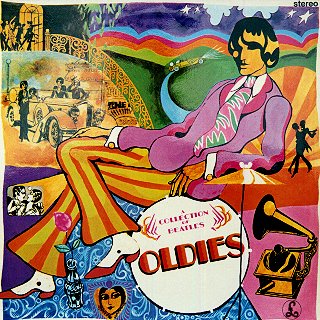
...Oldies, But Goldies! was released because George Martin knew that they were not going to be able to finish even a single for Christmas 1966, so EMI put together a collection of singles that had never been on an LP before in the UK, two LP-exclusive favorites ("Yesterday" and "Michelle") and "Bad Boy" was thrown in to get those who already had everything to buy it. (Although, if I was around, that beautiful cover art probably would have been enough to get me.) 
As for the song itself, it's pretty routine when compared to other covers, particularly the other Larry Williams ones. It's a nice update of the original (which features horns and a backup singer going "He's a...BAD BOY!"...thankfully they got rid of that) and features the boys on their usual instruments.
Today, you can get the song on Past Masters as well as Beatles VI, which is included in the The Capitol Albums, Vol. 2 set. 


Next up, we get into the meat and potatoes of the Beatles' career, starting off with probably the most important single of all time.     

Tuesday, June 22, 2010

#116: Tomorrow Never Knows

Written by: John Lennon & Paul McCartney
Released: August 5, 1966
Appears on: Revolver
Lead vocal: John


Revolver comes to a close with John's "Tomorrow Never Knows", the first song recorded during the sessions, when it started out as "Mark I". It's easily one of the most complex songs by The Beatles up to this point and probably in their entire career. 
"Tomorrow Never Knows" is really just a trip through the stream of consciousness. (As a Disney fan, I can't help but be compelled to compare it to the "Toccata And Fugue In D Minor" sequence in Fantasia.) John said that it's from his "Tibetan Book Of The Dead period", which was influenced by his reading and understanding of Timothy Leary, Richard Alpert and Ralph Metzner's book The Psychic Experience: A Manual Based On The Tibetan Book Of The Dead. However, this song isn't about what it's about; rather, it's about what's behind John's echo-drenched voice that sounds as much as an instrument as the actual instruments. Aside from their usual stable of instruments (save a rhythm guitar part), all four contributed to the insane, droning tape loops. Paul contributed the most because, contrary to what everyone is made to believe, he was actually the first Beatle to get interested in the avant-garde. George Martin added piano and also helped out with the loops. John added organ and tambourine parts and George added sitar. Keep an ear out for Ringo's stand-out drumming, which makes his amazing performance on "Rain" sound amateurish.   
An entry on "Tomorrow Never Knows" without a mention of rookie engineer Geoff Emmerick would be a mistake. He made an incredible contribution to the track, all outlined in great detail in his book, Here, There And Everywhere.        
"Tomorrow Never Knows" is such an innovative, out-of-this-world track that really blew everyone out of the water and still does, I think. As an ending it's perfect. Hearing it outside of its context (that is, as an ending) is wrong and thankfully, it has never appeared outside of Revolver (aside from its interesting use in LOVE). 
Ringo's contribution of the title is probably one of his biggest contributions to the Beatles because tomorrow truly never knows, especially when it came to the Beatles.    


Phew! That does it for Revolver! What's next? Before we get to the incredibly ground-breaking year of 1967, we have some house cleaning to do.  

Monday, June 21, 2010

#115: Got To Get You Into My Life

Written by: John Lennon & Paul McCartney
Released: August 5, 1966
Appears on: Revolver
Lead vocal: Paul


As we barrel through to the light at the end of the tunnel, the Beatles have a few more surprises for us. After the wild fade-out of "I Want To Tell You", horns and guitars come blazing on the stereo. I was alone, I took a ride, I didn't know what I would find THERE!!!!! 
"Got To Get You Into My Life" is one of my favorite Beatles songs and it is easily one of their most popular. When Capitol issued it on a single ten years after it was first released, it reached #7 on Billboard. That not only speaks for how popular the song is, but it was solid gold proof (literally; the RIAA certified it Gold) that the Beatles are timeless, even in the midst of changing musical tastes. 
The song itself is an ode to the great Motown records that the Beatles loved and even covered. Its built-in R&B style gave way to Earth, Wind & Fire covering the song, which became one of the most popular Beatles covers. Paul plays bass, John on rhythm and George on lead guitars with Ringo on drums. Then, George Martin is on organ, plus the horn section. Surprisingly, the horn players are not credited on the sleeve, despite Alan Civil's credit for "For No One" and Anil Bagwat for "Love You To". Anyway, here are the players: Eddie Thorton, Ian Hamer & Les Cordon on trumpet and Alan Brascombe & Peter Coe on tenor sax. (from Wikipedia, which copied it from Ian MacDonald)         
I don't know how often I've called the Beatles versatile on this blog, but "Got To Get You Into My Life" is definitely another piece of proof that confirms it. Just think of this: on just Side Two of Revolver, we've had a classical number ("For No One"), rock ("And Your Bird Can Sing"), pop ("Good Day Sunshine") and R&B ("Got To Get You Into My Life"). Plus, we still got one more to go. 
This song has appeared in only one other spot besides Revolver. In 1976, as previously noted, Capitol issued it as a single (backed with "Helter Skelter") to promote Rock 'N' Roll Music. Still, the song's popularity continues to this day, from its daily appearances on classic rock stations to Paul's repeated performances of the song.     

Friday, June 18, 2010

#114: I Want To Tell You

Written by: George Harrison
Released: August 5, 1966
Appears on: Revolver
Lead vocal: George


The Beatles really liked the fade-in and used it twice on Revolver: for the side-two opening "good Day Sunshine" and George's "I Want To Tell You". This song is also George's third - a record for him at the time. (In fact, the only time George has more than three is on The Beatles, a double album where he has two on each record.) 
The song features George on lead guitar, Paul on piano and bass (as well as adding some Indian style vocals at the fade-out), John on tambourine and Ringo on drums. 
Of his three songs, this is easily the slightest of them, only because it's just so normal. The lyrics aren't political like in "Taxman" nor are they philosophical like in "Love You To". George wrote only a small entry for "I Want To Tell You" in I, Me, Mine. Here it is:


I Want To Tell You is about the avalanche of thoughts that are so hard to write down or say or transmit. (As now in this book.)
If I were to re-write the bridge section now however I would have to say: 
Although I seem to act unkind
It isn't me - it is my mind -
That is confusing things 
The mind is the thing that hops about telling us to do this and to so that - when we need is to lose (forget) the mind. A passing though. 
"I Want To Tell You" was never issued anywhere else and was on the US Revolver
You know, quoting George's I, Me, Mine proves what an invaluable resource that book is. George was the only Beatle who wrote anything like it. Granted, his autobiography part (written with Derek
Taylor) is only 62 pages, but he wrote passages for every single song he wrote (save for the few he wanted to forget) up until 1979. Sometimes for George songs, I want to just quote the entire passage, but I have to maintain some sense of originality on this blog.


Also, this is being posted on Sir Paul McCartney's  68th birthday! So happy birthday Paul! 

Tuesday, June 15, 2010

#113: Doctor Robert

Written by: John Lennon & Paul McCartney
Released: August 5, 1966
Appears on: Revolver
Lead vocal: John


Ring my friend, I said you call, Doctor Robert...


I really wish there was more to say about "Doctor Robert". It's such a funky tune but other than recounting the story that the song might be relating, the song is not written about all that often. (Just look at the wikipedia page...even the page for "Wild Honey Pie" is longer.) 
The story the song might be based on was retold by George in detail in the Anthology. John and George were visiting a dentist friend. When they were reacting rather strangely to the tea they were  drinking, they found out that the doctor had dropped LSD into their cups! The best part of the story is easily their reactions on an elevator, where suddenly they thought it was on fire! (Dig out your copies of the Anthology and watch it - it's really funny.)
Although, it might have nothing to do with that story. It might just be about how easy it was to get drugs in those days. If you knew the right people, you got the right stuff. Well, well, well, you're feeling fine. Well, well, well...he'll make you...Doctor Robert!!! 
The track features John's double-tracked vocal, rhythm guitar and harmonium. Paul plays bass and adds background vocals. George's lead guitar is double tracked (he's also playing maracas, apparently) and Ringo on drums. So, there's nothing out of the ordinary, at least when compared to most of the other songs on the album.
"Doctor Robert" has never appeared anywhere outside of Revolver, but it was the last of the three songs issued early in the States on Yesterday...And Today